
Gastrotourism through the Protestant Lens in Altamura
At the Antico Forno di Santa Caterina – one of Italy’s longest in continual use ovens, a cluster of pensioners and misc origin travellers in pastel-coloured athleisure huddle around excitedly. The ancient furnace lures them in with display mounds of bread weighing 5kg. These edible kettlebells are fondled, stroked and photographed. Foreplay before focaccia.
Opposite the Antico Porno di Santa Caterina, two superstar grandmothers form mounds of pasta into oblong shapes with their well practiced hands. Positioned at a table in a cavernous cloister, it’s an OnlyFans live for lusty gluten fiends – a titillation, a brush with Instagram celebrity, before they enter the furnace of sin.
The bakery is in Altamura- the self-proclaimed City of Bread. Its historic cloisters and narrow alley ways once housed Saracens, Jews and locals- a medieval micro-Anadalusia under the rule of Federico II in the 13th century. Now they are home to tables, chairs, fairy lights, nonsense bunting and neon lights declaring I Heart Focaccia. Cloyingly instagrammable and instantly depressing.
By night, Altamura gleams. Its streets are paved with ancient white slabs of stone buffed and polished like enamel – they are the pearly white smile of the city. Its youth dresses in black- they are the offspring of a comfortable nouveau riche set of entrepreneurial boomers. They pose and drink and skulk like post-metal meta goths and seem happy enough although I suspect they crave more edge to counter the smooth and beautified white.
Years ago on a solo trip to Budapest, I was struck by a conversation I eavesdropped by two strappy topped Valley Girl types in their late twenties:
–It’s so funny how the goulash in Prague is so different from the goulash here
-I know
–I feel so bad. I’ve been eating so many carbs- this morning at breakfast it was all like bread and cheese and I had maybe a sliver of a cold cut and that was it.
Her guilt amused me. They were both clearly athletic and youthful enough that they could easily handle a carb-heavy breakfast. Especially with all the moving around. And yet, the guilt was palpable. I could sense her unease with the abandon with which central Europe approached carbohydrates. She was out of sorts with it all.
There is an Anglo-Protestant desire to create binary decisions surrounding food and pleasure.
Protein is good- it helps muscle repair and so complements the protestant work(out) ethic. Carbs are bad. They convert to sugar and unless they are put to use immediately, will be stored and converted to fat. Highly impractical. Not a pragmatic use of nutrition. Frivolous even.
So indulgences must be counterbalanced with cleanses and gym sessions – in short, denial, resulting in a twisted and suppressed sort of Catholic mea culpa.
It seems Northern Protestantism and its pragmatic approach to food is at odds with southern abundance, joy and divine absolution. In its absence, guilt manifests in the relationship with the body. Visitors from the Anglosphere will undoubtedly detox after a five day stint of doing Italy. A week of Italian carbs amounts to nutritional betrayal.
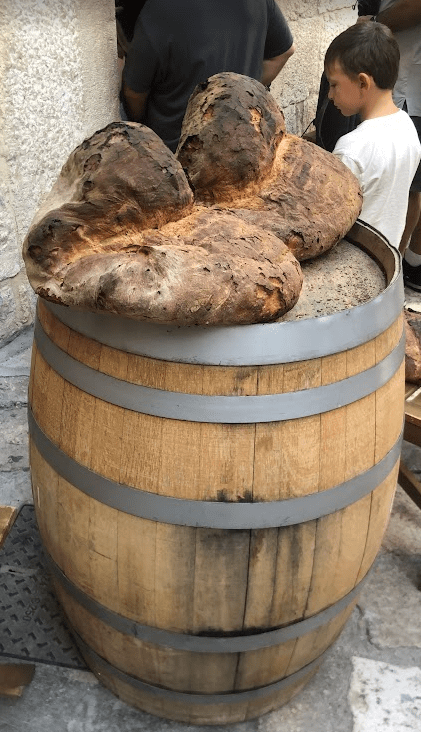
Altamura’s identification with the humble loaf of bread is touching. They owe their wealth to the simple grain and it is right that it has Protected Designation of Origin status. And it is also fitting that in 2025, the use of social media propel Altamura to international commercial heights. The simple oven attracts people from far and wide and drives Euros into the hands of the city’s breadlords. It has become a new form of holy pilgrimage.
But for the gluttonous gastrotourists, this is unholy prostitution. It is food porn in its most obvious sense. The Antico Forno di Santa Caterina, a red light district in which tourists are tantalised, tempted, tormented.
Instantly consumable – they crave that fleeting gratification of umami and satiety, but end up with mere masturbation of the taste buds and chronic bloat of the gut.
In this age of Insta-travel, IBS is the new STDs.
 Farida F. Alvarez
Leave a comment