
Dis – oriented (& other stories)
Oran is like going back in time to vintage southern France and then coming back to the future again after an apocalypse. Less austere than Algiers’ Parisian all whites, Oran welcomes you in with sun-soaked pastels and sandy yellows. In 2016, it was still a treasure-trove of vintage shop fronts, restaurants, patisseries and painted business signs.
The impressive cathedral built in 1913 is now a national library and study hall. I had never before visited a deconsecrated cathedral of that stature, and the feeling was, quite simply, bizarre. Standing in the middle of the sacristy in order to get a better look at the cupola and gauge the scale of the building, I felt like a naughty Catholic schoolgirl in what would normally have been an out-of-bounds area. I saw the decaying state of the throne-like seats and pews, now covered in newspapers and plastic; a tardy, improvised countermeasure against blasphemous birds, evacuating themselves from above. The stone tabernacle, once entrusted with the holy sacrament, now encrusted with unholy excrement. It all felt like an elaborate insult directed not at the religion, nor the faithful the building was intended to receive, but to the French and the arrogance with which they assumed they could just pitch up, build cathedrals willy nilly, and create a ‘New France’. The gall of these gauls!
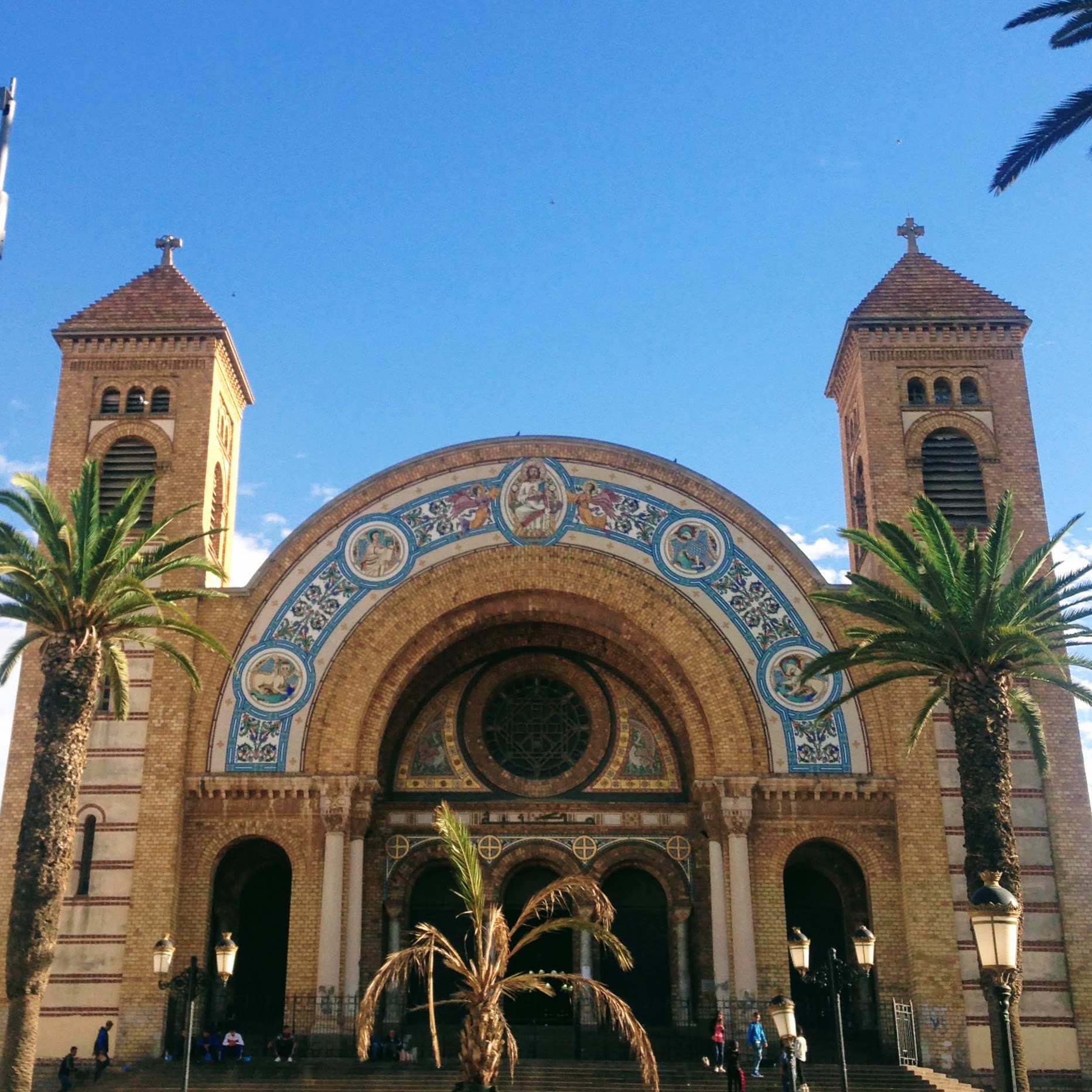
Walking around town, every five minutes my father would point to a building and tell me how it was once a wonderful bar, cafe, or discotheque but now, “I don’t know what they are doing…”, he’d say, in a state of perpetual disappointment. “C’est la déglingue”, It’s all falling apart. The bars may still be there, but the windows are obscured and the doors are kept shut, opening only at night for their male clientele, many of whom have lost the art of drinking for pleasure (if they ever had it to begin with). The discotheques my father frequented in the 60’s to listen to Elvis, Mina and The Beatles have all gone. The clubs have actually moved to the outskirts of Oran, and in the summer, down along the coast to beach resorts like Les Andalouses. Out of sight and away from judgmental eyes it seemed to me. I was relieved to learn that there was a ‘scene’ out there when I did, but again, felt saddened when I remembered that this was further evidence that these beautiful city centres are falling apart, brick by brick and in spirit; haunted by the spectre of their European past and populated by tortured souls, howling into the night.
It was cool to have this tour of yesteryear, but also depressing. I was also concerned that I was becoming some sort of orientalist supremacist. “Too bad Ali the Arab doesn’t know how to maintain these charming buildings! Crying shame!”
So when I left central Oran and my dad to stay with another cousin and her two teenage kids out in the modern social housing estates, it was an unexpected relief. Modelled somewhat on the French banlieu, the housing estate I visited felt lively and safe, populated largely by families and buzzing local businesses. But unlike the stereotypical images of Parisian banlieus featuring disenfranchised North African youths setting cars on fire, this felt peaceful. As though perhaps people appreciated having the extra communal outdoor space, and were comforted by being away from the city centre with all its reminders of French occupation, and then later, civil war. Present, were palpable ripples of the Modernist dream; here lies an opportunity to start again. Rebuild a society; tabula rasa. (Just don’t expect the lift to work, that’s all).
The great thing about teenagers is that in today’s hyper-connected social media world, they’re basically all the same. So what else was I going to do with my teenage cousins but take selfies and Snaps and compete for likes on Facebook. Frankly, it was goddam liberating. I could just close my eyes, or stare into my phone (like teenagers do when they go into a special, silent, moody phone trance), and feel like everything was normal. Here, my thoughts started to drift away from intense history lessons from my Tata in Algiers, or my dad’s cynical, Algerian character assassinations (“ce sont des voyous!” they’re all crooks). Away from my self-induced architecture saudade; feelings of nostalgia for an early to mid-twentieth century architectural vernacular, lamenting the lack of respectful architecture as I saw the old vandalised, neglected and destroyed. (Although, this is a constant preoccupation of mine, I have it London too).
Spending time with young people I was, thankfully, brought back to the present day. My biggest preoccupation now no longer revolved around neglected buildings, or issues regarding women’s place in society; rather, I wanted to know was up with all these dudes in counterfeit Birkenstocks and socks. And I don’t mean the Californian hippy professor, Birkenstocks and slouch socks look. I mean the single strap, orthopedic Scholl sandal looking ones. The ones that should be banned immediately. But with socks. What was their deal, and why? Aesthetically; ugly. No question. But popular? Incomprehensibly, yes. It seemed at first to be a permutation of the Nike slides and socks subculture that’s been popular for a while, but really started to pick up traction a couple of years back. It’s like a jock in chill mode, fresh out of the gym. Just a very laidback look.
I asked my 18 year old cousin if he ever rocked the Birkenstocks and he said NO WAY. He was all about the Lacoste shirts and Nike TNs. Then when I saw a fellow with the Birkenstocks and socks wearing a prayer dress, it all became clear. I was now face to face with Muslim Athleisure; Oran style. You see it London too except here, in less clement climes, the overarching look is more ‘pious Atlantic fisherman’. Heavy beards, beanies, puffa jackets, prayer dresses and Nikes.
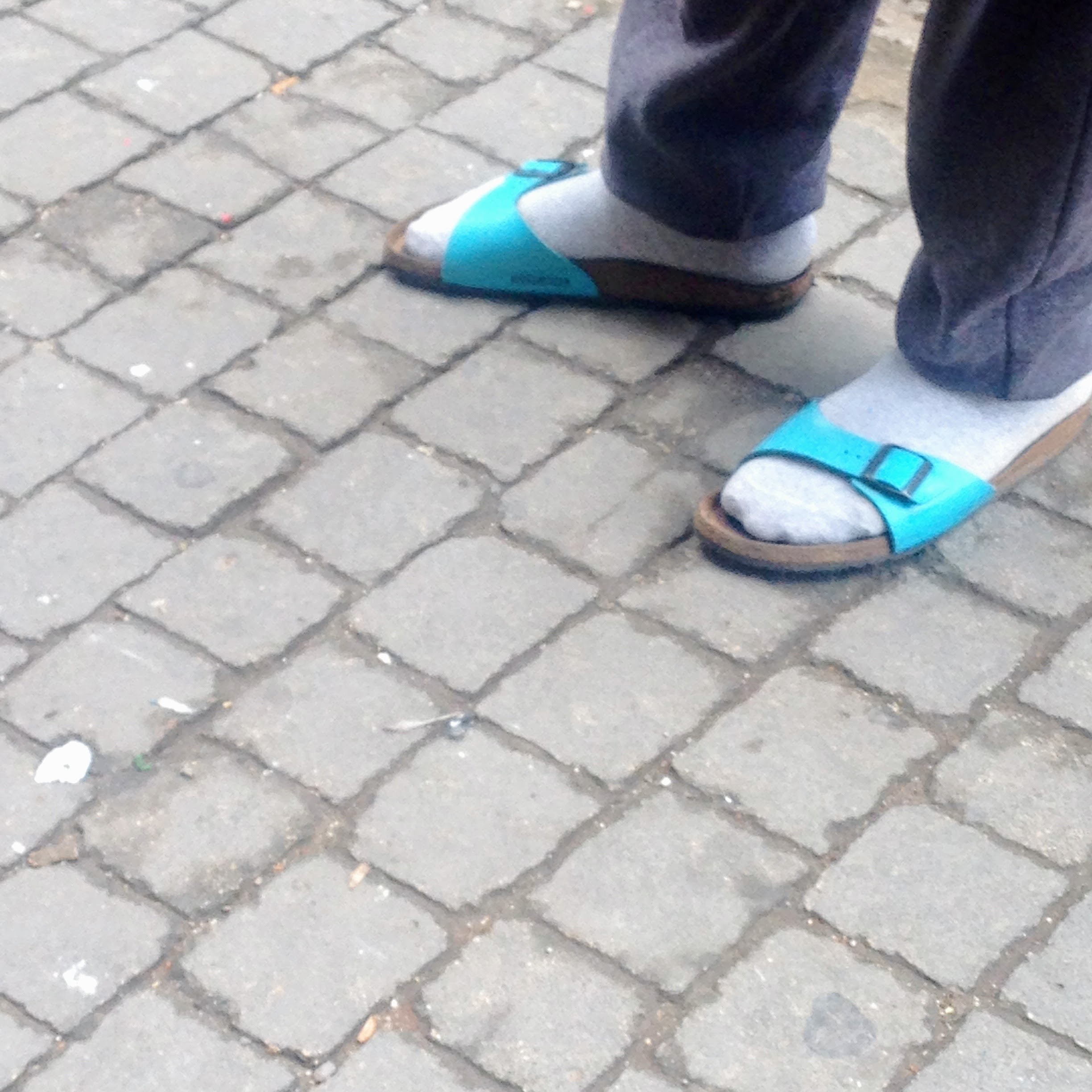
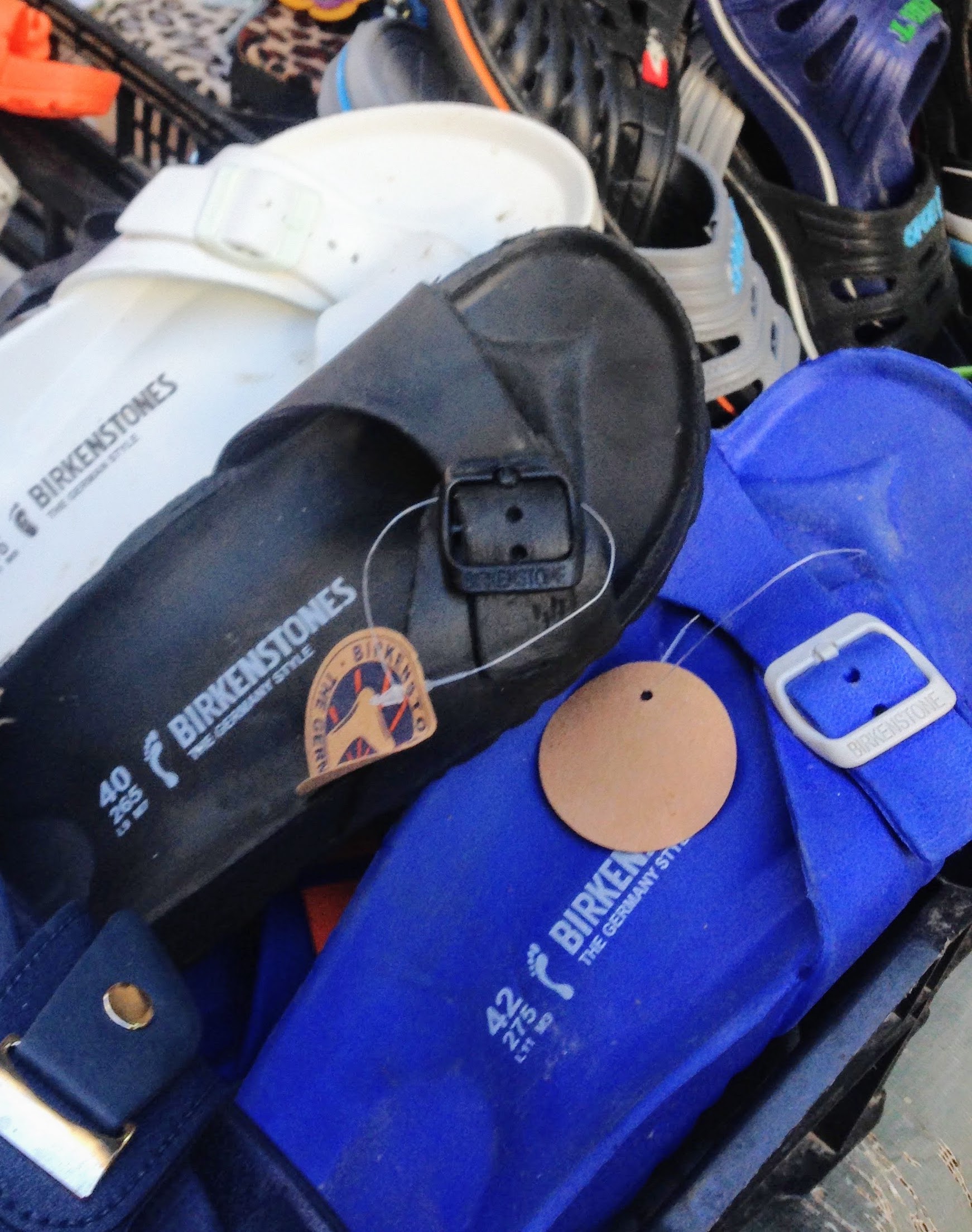
Sandals and socks combine fashion and function. Since everyone is required to remove their shoes before entering the mosque, it provides a quick slip-on-slip-off solution. Surely, a more elegant homegrown option for this in the past was the slip on, leather babouche. These days, fellas are rocking the Birks. It’s laidback, aspirational, and strictly pour homme. Since not everyone can afford real Birkenstocks, a wealth of imitations have flooded the market; from Birkenstones, to Birkensticks. White, plastic Birkensticks were my particular bugbear, and as far as I can tell, the ultimate Algerian Chav look is speeding through town in plastic Birkensticks and socks on a moped with your best bro straddled behind. Of this last scene I have no photographic evidence, but perhaps it’s more poetic to imagine a couple of happy-go-lucky garçons algeriens taking a ride along the coast; the wind rushing through their hair all the way down to their socks and their impossibly impractical footwear. Happy. For at least in those moments, they are free.
Je vais à la chicha pour les beurettes


One day, my teenage cousin took me to what he jokingly referred to as ‘Boulevard Shisha Club’. It was a street near his neighbourhood (the friendly, Modernist housing estate), and from the bus he pointed out about ten shisha cafes more or less in a row. A couple of clubs lay hidden beneath too, he assured me. So one afternoon we went and listened to French/North African rap, and Rai music, drank a Coke and smoked some shisha. Inside were discreet young couples holding hands, and the odd table or booth hosting a smattering of mixed gender teens. There was one young girl I distinctly remember, trying to sleep in one of the back booths looking like she was nursing a hangover from hell. It was all fine, nothing you wouldn’t find on Edgware Road (minus the flashy Arabs in Ferrari baseball caps). I asked p’tit cousin how come we didn’t come a little bit later on that evening, so I could see the ambience and check the ‘scene’. He hesitated, and essentially implied that if we came any later we would risk seeing “unpleasant things”. I sought clarification. I don’t respond well to over-protectiveness, unaccustomed as I am being a Londoner and an only child. He then went on to say that it is not uncommon for a fight or two to break out in the evenings outside these clubs. Ok, I replied. “Well, I’m from England and so I’m used to that…”, I explained. He’s never been to England, so he wasn’t really necessarily going to be aware of our shameful binge drinking culture. OK, he said, but people also, you know, … “What?”, I said, imagining the complete worst. “Well, sometimes, people do drugs”. This was so sweet and I wanted so much to reassure him, that it was okay and that I wouldn’t be shocked.
The sad thing about all of this, and it was the case with my over-protective cousin in Algiers who warned me against wearing short skirts, and my other cousin in Oran who took me to a market one day to find “artisanal’ shops, but accidentally took a wrong turning, so we wound up in the bowels of the working class street market with stall traders and men, housewives, teenage boys, all shouting and clamoring over each other, selling everything from dates, plugs, knock-off Birkenstocks, to Chanel hijabs, pomegranates and underpants. Looking harangued and ashamed, she said to me, “I’m sorry, I didn’t want you to see this”. I laughed and told her it was fine. That I liked the market. Actually I was annoyed she was walking so fast ahead of me, I wanted to buy some counterfeit Chanel slippers, but she clearly wanted to get away from these chavs as soon as possible.
And now with my teenage cousin, not wanting me to see the shisha club in the evening in the event a couple of unsavoury types should turn up…all this failed sugarcoating was just making the flaws all the more apparent. Had I seen for myself these young people at a shisha club/Rai music rave, yes, maybe secretly taking drugs in the toilets, and getting a bit too gregarious with it outside, I think it may have helped to normalise the country for me. Humanise it a little. An opportunity to witness young people decompressing, reacting, releasing. The worst thing you can do is act like it’s okay, when it is not. And I’m okay with things not being okay. Nowhere is perfect.
When my Tata, who has lived in America and has travelled the world with her job, in response to my observation that Algeria is a patriarchal society said things like, “But the women are happy here. The men buy them gifts and take them to restaurants sometimes….”, I wanted to scream.
I thought of the young woman at the shisha club, nursing the hangover from hell, trying to get some sleep. What hells is she suppressing? What frustrations does she let out at night in the dark and smoky shisha club? What does she want to yell into the abyss? Algeria is not Iran, women at least have the freedom to do what they want with their hair. And on paper, there is equality. But there is also an insidious, regressive mentality, eating away at the core principles of democracy. A blatant hypocrisy as regards values and roles in society. When, in 2016, you have female ministers suggesting that married women in employment should offer their salaries to the government to help ease the public deficit (since they have husbands who look after them anyway), you begin to understand why people need to find their pressure valve. An opportunity to release. In Algeria, I sincerely hope they find it.

ADDENDUM: Folk art and Chickpeas
Calentika
Calentika is a savoury chickpea flour-based flan, supposedly invented by the Spanish during their occupation in Algeria. It literally means “a little bit hot” as in “una cosa calentica = a little bit of something hot. I’ve never seen it in Spain, it seems like something you might get in central or western Spain, but people in Oran seemed to take great pleasure in the fact that this was a small piece of Spanish heritage. It’s funny how one group of colonists can obliterate the memory of another. I’m sure had the French not colonised Algeria, the Spanish would still be thought of as greedy occupiers. And had neither the Spanish nor the French arrived, perhaps the Ottomans would be remembered less fondly. Now Ottoman folkloric costumes, that have greatly influenced the traditional cityware of Algiers and Oran, along with Turkish hammams, palaces and art are all revered and treasured. No one speaks of their bloodthirsty pursuits and the battles that took place to gain the stronghold in Algeria’s cities. The blood spilled on Algerian streets by the hands of the French (still using guillotines revolution style, in the 50’s) is a little fresher in the mind. That said, Algerians still love Camembert and produce several very fine camemberts of their own.
In and around the market, there are several calentika take away joints.

All day everyday, these dudes are shovelling trays of chickpea flan in and out of ovens. They industriously cut the ‘flan’ up into squares, expediently place each square into fresh crusty baguettes, and finally dust them down with some salt and cumin. Harissa sauce is optional (but recommended), and all for an extremely modest sum. It’s an Algerian street-food scene the likes of which Yotam Ottolenghi would have foodgasms about, and I’m quite surprised he hasn’t jumped on it. But he’d probably want to do something innovative with pomegranate molasses, or warmed up greek yoghurt, or za’atar. You know what, forget it Yotam. Just leave it.
Kabylia
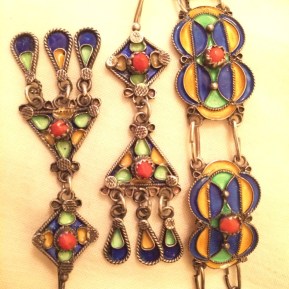
For as long as I can remember, I have had a bracelet belonging to mother, appropriated so long ago I sincerely believed it had always been mine until I was corrected. It’s a pretty silver thing, painted and encrusted in primary colours and precious stones, blue, yellow and coral red. Since my mother worked for years at a pseudo hippy jewellery store in Carnaby street at the tail end of its heyday, I always assumed it was Mexican or something, like so much of the turquoise and silver in her-now-my possession. But at some point I learned that it was in fact Algerian, and more specifically, a typical example of Kabylie folk artisanal jewellery. I’m partial to artisanal jewellery of all sorts anyhow, so before going to Algeria, I looked into it a little. And a love story was born. In fact, the clasp had been broken for a while, so I took my mother’s bracelet (a gift from a relative of mine eons ago) back to Algeria, resolved to take it to a jewellers to have it repaired. And also to scope out matching necklaces, earrings and what ever else I could get my hands on. It wasn’t long before I realised that these were available to buy in most shops, and were there more of a tourism industry, they would be a sure fire hit. One of my cousins kindly gifted me a pair of earrings that matched my bracelet, which I did get repaired in the end, and I am very happy with my set which I have worn in London since. Very “ethnic” as a friend says. Which is also “very me”. “Thank you” I always say. I really don’t think there’s any other response to that.
Growing up, in the few times my Dad could bring himself to string two sentences together about Algeria without losing his temper, he managed to clarify that “we were not Kabyles”. “What’s that?”, I’m sure I replied. “What’s a Kabyle?”. At this point he probably would have lost his patience and I would have switched off.
So I asked my cousin’s husband in Algiers, who is one. Kabylia is historical region located east of Algiers occupying a territory from the Mediterranean coast to the Atlas mountains. Goat herding, rural folk I guess. And big, BIG on folk art. This particular Kabyle, made it down off the mountain and into Algiers at some point in the 60’s when he would have met my cousin. In crystal clear French, he gave me a concise history of Oran, that it was under Spanish dominion for 200 hundred years, and that the name Oran in Arabic, Wahrain, means two lions. There were lions sighted on the Algerian coast until as late as the 19th century. It was refreshing to have some Algerian history recounted to me like that by a friendly, well-meaning, educated old worldly type.
But then of course I learned that ‘old world’ was right. Later I learned, he has always refused, and still does, to have a man, any man, who is not sanctioned by him, or that is not a family member enter his house.
What?
My Sorbonne-educated cousin said, sometimes you just have to accept that for certain things, it’s still the 18th century.
What?
My dad may have always been too salty to explain Algerian history to me, but at least he has never, EVER, interfered with my life, nor with whom I see or don’t see, and certainly never with whom I have chosen to live with out of wedlock. (And considering I have a Catholic-raised mother and a Muslim-raised father, I really lucked out on that one). For all of this, I must summon my Christian notions of gratitude, and through agnostic gritted teeth, I am grateful.
 Farida F. Alvarez
Leave a comment