
Orientalism, or Too Many Arabs…
My father’s Arab dad joke about there being too many Arabs, was in the end, a fairly accurate description. Regrettably, urban (though not desert) tourism is virtually non-existent. People breaking the Maghrebin monotony in Algiers were few in number and could be categorised as either well dressed, young sub-Saharan Africans or stray Europeans or East Asians with briefcases. The young Africans are most likely there on university scholarships (a sort of African Erasmus), while the westerners or East Asians tend to be either diplomats, academics or oil and gas representatives. You see them in town having a coffee, or looking confused in the gift shop. In short, most people appeared to be there because they had to be, and not because they wanted to be.
And then there were the Chinese. I had heard tell of Chinese traders at the market, arguing and haggling in dialect with locals, angrily refusing to be spoken to in English or French. My cousin once witnessed an irate Chinese guy yell at a trader, “No, no! You speak to me in Arabic!”, presumably having come to the conclusion that as an outsider, you get less of a fleecing when you speak the lingo. I was keen to see for myself, although most are there as construction workers, hired by international conglomerates to build hotels outside of the city. Tickled by my orientalist, Adventures of Tintin curiosity, it became something of a game for me whenever I would see one. (In Search of the Chinaman of Algiers … I’d read that comic).
Day two: spot a rabble of Chinese men wearing pale blue overalls bearing their company’s name on the back, accompanied by a local guide. All excitedly make a beeline for the jewellery shop (collect 10 points!!).
Day four: another sighting at a sardines-only greasy spoon. (A family-friendly place patronised by old-timer couples and businessmen on their lunch breaks, it felt reassuringly Mediterranean, as though we could have been anywhere from Istanbul to Palermo). A lone Chinese woman enters the cafe with a smile on her face as wide as the door. “Salam Aleikum! Salam Aleikum!”, and then discreetly pulling a shiny black Samsung from her canvas bag continues, “…téléphone?…” We all shake our heads politely and decline. She smiles graciously, slips out and carries on about her day (5 bonus points!!).
As far as I can recall, it was my first time hearing a Chinese person speak Arabic, and an extra novelty in monocultural Algeria. In the end I never did get to see an Algerian-Chinese haggle-off down at the market, although it later occurred to me that the sight of Chinese traders squabbling with Arab merchants is nothing new, however much the idea amuses me.
[Featured image : Les amis orientalistes. Algerian mint tea glass next to a Chinese green tea tin from home.]
China enjoyed a healthy trade with the Maghreb (poetically, Maghreb is Arabic for sunset) in textiles, spices and tea for centuries. North African mint tea is traditionally made with Chinese green tea, and there has always been a tin of trusted, Chinese Gunpowder branded green tea at home in the cupboard. While I always order it at Chinese or Japanese restaurants, it never occurs to me to drink green tea at home. Mintless and sugarless, it seems somehow redundant within a North African context.
I think the same could be said for many things in North Africa, and I couldn’t say this with 100% scientific certainty, but it was a surprise for me to learn that lifts never work in Algeria. In apartment buildings such as my cousins’, they have become redundant.

My cousin (which is to say my father’s cousin, but really as long as there is direct lineage it’s all cousins) lived through and actively took part in the battle for independence, starting in 1954 and culminating in 1962. She is a patriot. She is also losing her marbles. As the guardian of family secrets of which my father is either ignorant, or hasn’t the emotional sensitivity or storytelling capabilities to share, I value her as a family member. As an impartial adult, it really tries my patience when people start talking about conspiracy theories involving the Jews, politicians and the Illuminati.
I learned that she was involved with many initiatives during the post-independence period, and she speaks with great pride regarding the academic talent that Algeria has produced, and laments the inevitable brain-drain given the limited opportunities for those with knowledge.
One afternoon over coffee she proceeds to tell us about her neighbours in the building. So and so is a doctor. And so and so is an engineer… Like this, giving micro curriculum vitaes for the whole building. An educated bunch. “And so you see”, she says with a proud, nationalist glint in her eye, “Algeria prepared her people well. We are educated”. And I regret it now, I should have just let this old woman have that one moment of pride, but I did not. The illuminati talk had got to me a little. I pointedly asked her, “and so how is it, that between all you engineers and doctors in the building, you couldn’t be organised enough to arrange to have the lift fixed?”
“It’s not as simple as that”, she said, with a heavy heart. I had burst her bubble, and I instantly felt a little bad for it. So I tried to reason. “Is it because people deep down, don’t trust each one another? That would be understandable after everything that has happened..”
No, she says. “It’s because the Algerian is an individualist”.
I didn’t buy that explanation when she said it to me then, and I’m still not sure I buy it now. What does that have to do with building maintenance? I wanted to believe that it was more than that, and I know there is no one simple explanation. There are still many things that confuse me about Algerian society and Arab culture. It seemed to me that perhaps by standing by, doing virtually nothing to save these buildings, somehow they were accepting the “will of god”, which just also happens to collide with a violent undoing of a previous and exclusive architectural French utopia.
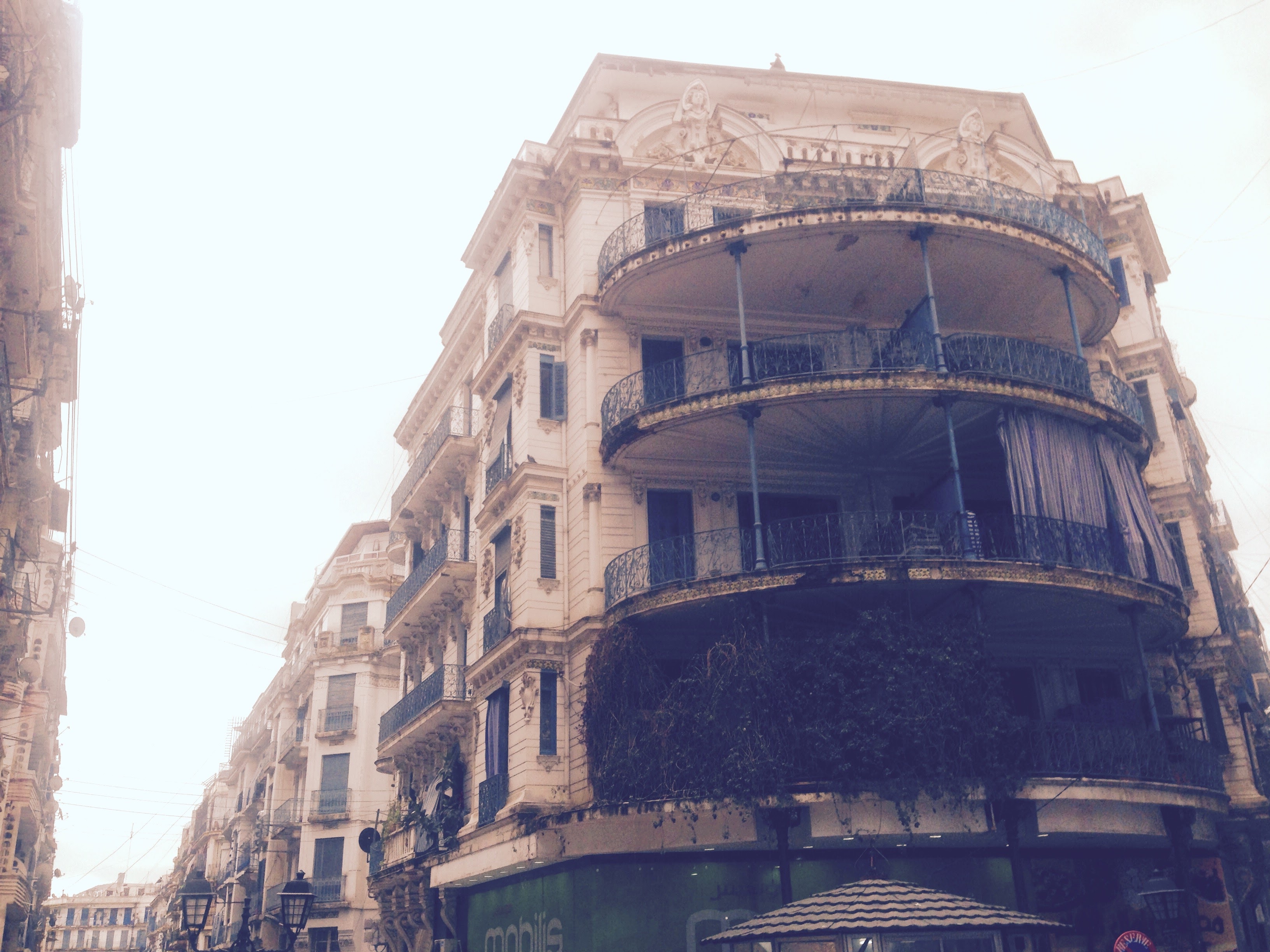
“A uniform yet distinct arrangement of white balconied apartment buildings; the ultimate expression of sophisticated, continental metropolitan living.”
At least this is how I would describe the city if I were writing for an orientalist time-travel agency brochure. For apartment buildings in central Algiers are the stuff of dreams. They boast the best in 19th and early 20th century French architecture. Baron Haussmann himself of Paris civil engineering fame had a hand in the design and layout of Algiers. I had heard of Charles de Gaulle famously insisting, “L’Algérie, c’est la France!”, and I thought I had understood what he meant in colonial terms, but I hadn’t quite understood what that would mean IRL.
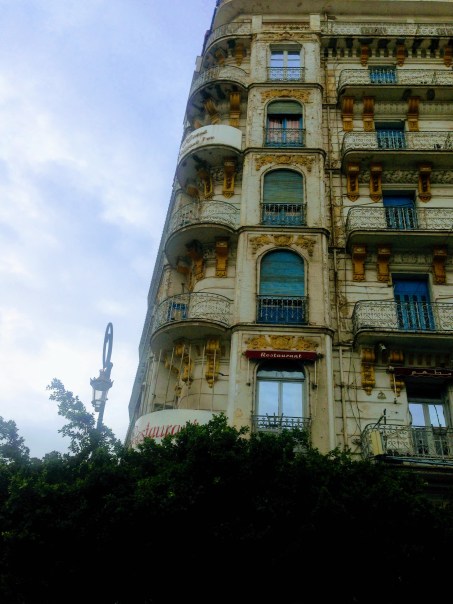
Algeria, with its Mediterranean coastline and its painful proximity to Europe is geographically closer to France, yes. But it is the extent, determination and scale with which the French really went to town here. Swathes of beautiful buildings fit for purpose; huge, light-loving windows, delicately designed shutters to block out the sun. Street view balconettes from which to observe the hustle and bustle below. The ground floor reserved always for street-level commerce, entertaining, wining and dining. Grander than grand street doors and foyers to welcome residents into the building. Art deco design, or Moorish tiles or both adorning the floors, halls and walls. In addition to this, are the divine Ottoman palaces spread throughout the city, many nestled in the heart of the Casbah as well as within the French quarters. It’s as if a stylist from Anthropologie got his hands on the set from Poirot. And just really went wild with it , you know.


Under French Apartheid, all this stylish grandeur was largely inaccessible to Arabs. Whole streets and neighbourhoods, parks and gardens were restricted areas. Europeans only. The charming Jardins de La Liberté next to my cousin’s apartment were thus named since in their pre-independence years, these were a no-go zone for Arabs. (Ironically, today they are a no-go zone for everyone as they have been closed for a year and a half for “essential works”, and are now frequented only by sneaky, noisy, night-drunks).
Under French rule, Muslim Arabs were confined to the Casbah, while Europeans enjoyed their cities and basked in the mediterranean sun. The French in their apartments, The Arab in the Casbah, God made them high and lowly, And ordered their estate. A takeover of these apartment buildings took place in the wake of the post-independence European mass exodus. Family members and my father spoke to me of people breaking in and taking over, often inheriting fully furnished apartments, grand pianos and all. Eventually the placeholder government was able to take back some semblance of control and began a housing distribution programme. But this was squatters’ rights on a national and unprecedented scale. In large part, the inhabitants of many of the grandest apartments in Algeria’s cities are, or descended from squatters, but this was all part of the people’s revolution. The poor took back from the rich. Impressive really; even Che Guevara was a super fan, visiting in 1963 as a representative from Cuba. The Algerians were so grateful to have his support, they named a boulevard after him in Algiers.
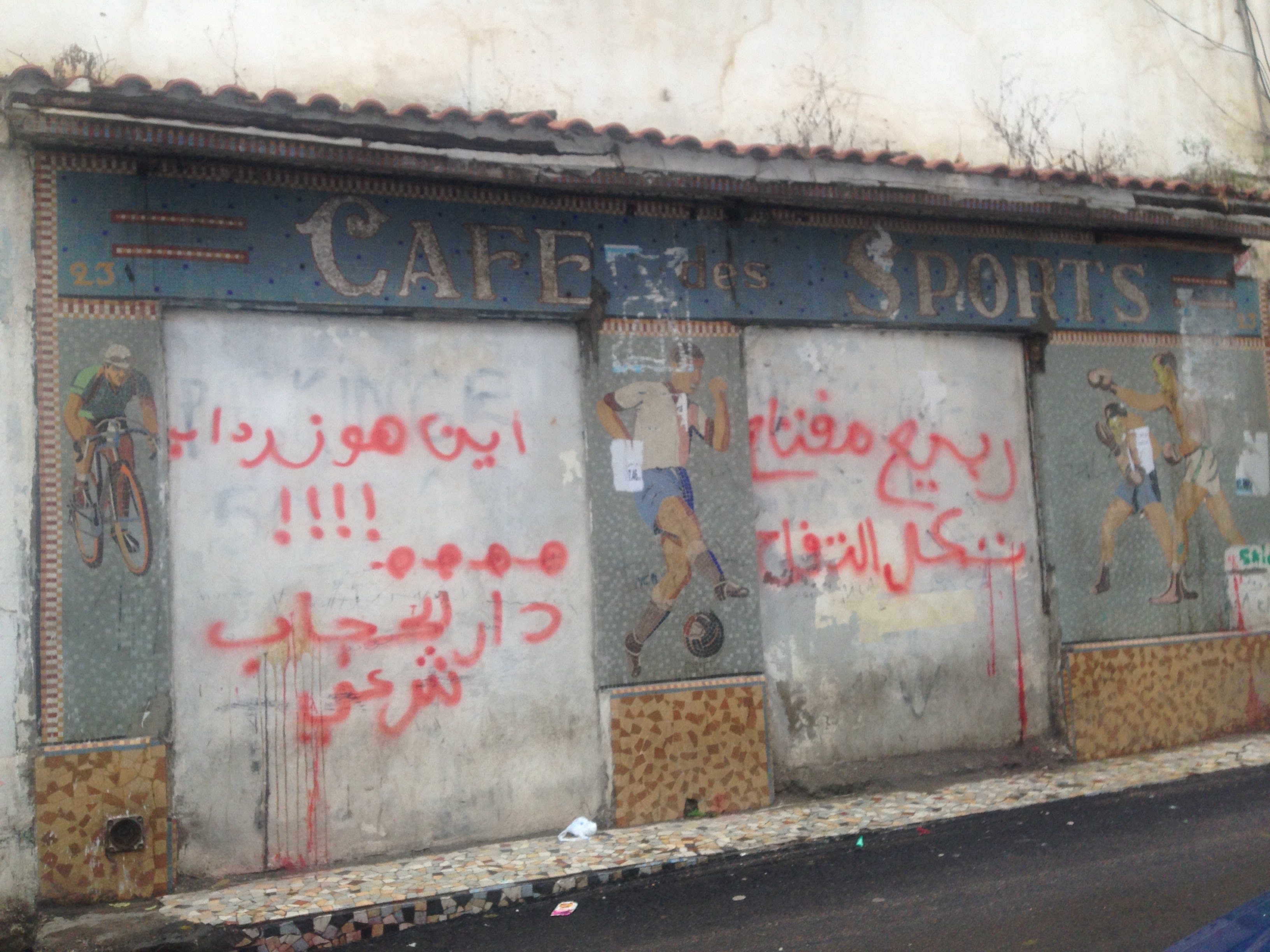
Today, many apartment and commercial building facades and interiors are left to deteriorate. And everywhere is crumbling French hubris, colonial opulence in decay. I saw some sprucing here and there, and make no mistake; state-owned buildings and embassies looked just fine. The government see to that. But for general folk, neighbourhoods and local businesses seem to be less inclined (not to mention less financially disposed) to up their game. Who do we need to impress? These Arabs? What for? They wouldn’t appreciate it anyway. Literally things I heard said by Arabs about Arabs.
And the lift never gets fixed.
In my next post things get real when I face my Fatherland issues.
 Farida F. Alvarez
Leave a comment